
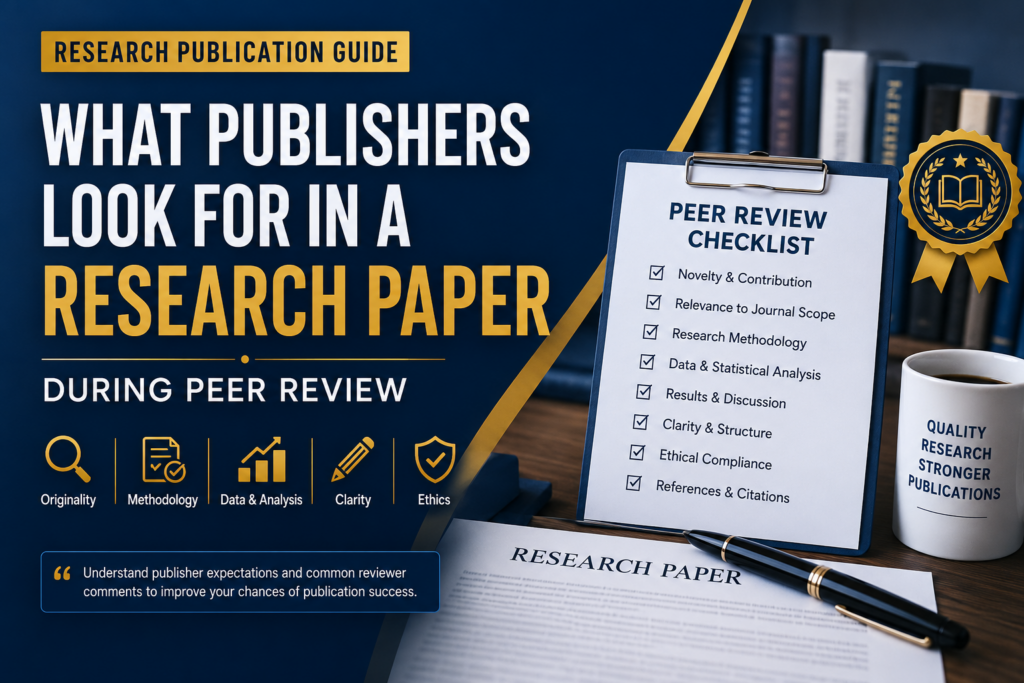
What Publishers Look for in a Research Paper During Peer Review
Understand the evaluation criteria used by journal editors and peer reviewers before accepting your manuscript. Learn the most common reviewer comments and discover how to improve your chances of publication in Scopus, Web of Science, SCI, and PubMed indexed journals.
Why Understanding the Peer Review Process Matters
Every year, thousands of research papers are submitted to international journals, yet a significant number are rejected before publication. In many cases, rejection is not due to poor research but because the manuscript fails to meet the expectations of journal editors and peer reviewers.
Whether you plan to publish in a Scopus-indexed journal, a Web of Science journal, an SCI/SCIE journal, or a PubMed-indexed journal, understanding how editors and reviewers assess manuscripts can substantially improve your publication success.
Many journals reject manuscripts before peer review due to poor manuscript preparation, lack of originality, formatting errors, weak methodology, or because the research falls outside the journal's scope. Preparing your manuscript thoroughly before submission can save months of revision and increase the likelihood of acceptance.
Peer review is designed to ensure that published research is original, scientifically rigorous, ethically conducted, and valuable to the global research community. Reviewers evaluate not only the novelty of your findings but also the quality of your methodology, the strength of your analysis, the clarity of your writing, and the relevance of your conclusions.
In this comprehensive guide, International Study Group (ISG) explains the key factors publishers consider when reviewing manuscripts and shares the most common reviewer comments authors receive during the publication process. By understanding these expectations, researchers can prepare stronger manuscripts and navigate the publication journey with greater confidence.
What Publishers Look for Before Sending Your Manuscript for Peer Review
Journal editors act as the first gatekeepers in the publication process. Before a manuscript reaches peer reviewers, editors conduct an initial screening to determine whether it meets the journal's editorial standards, scientific quality, and scope. A well-prepared manuscript has a much higher chance of progressing to peer review than one with avoidable shortcomings.
Below are the key criteria that publishers and journal editors evaluate before deciding whether to send your paper for external review.
| Evaluation Criteria | What Editors Expect |
|---|---|
| Originality | The manuscript should provide a novel contribution to existing knowledge. |
| Journal Scope | The research should align with the aims and scope of the target journal. |
| Scientific Quality | The methodology should be rigorous, transparent and reproducible. |
| Ethics | Appropriate ethical approvals, declarations and research integrity. |
| Language | Professional academic English with logical structure. |
| Formatting | Compliance with the journal's author guidelines. |
1. Originality and Novelty
The first question every editor asks is:
"Does this paper contribute something new?"
Novelty remains one of the strongest indicators of publication potential. A manuscript should clearly explain how it advances current knowledge rather than simply repeating previously published work.
Novel contributions may include:
- Introducing a new research methodology
- Developing an innovative analytical framework
- Presenting previously unavailable datasets
- Improving existing technologies or algorithms
- Applying established methods to new research contexts
- Providing new theoretical insights
2. Relevance to the Journal's Scope
Even excellent research can be rejected if submitted to an unsuitable journal. Editors carefully compare every manuscript against the journal's aims, readership and subject focus.
Before submission, researchers should evaluate:
- Research discipline
- Article type accepted
- Target audience
- Recent publications
- Special issues
- Impact and indexing status
Submitting to a journal outside your research area often results in an immediate desk rejection without peer review.
3. Clear Research Objectives
Editors and reviewers expect a manuscript to answer a clearly defined research question. The objective should be specific, measurable and scientifically relevant.
| Weak Objective | Strong Objective |
|---|---|
| To study artificial intelligence. | To evaluate the effectiveness of deep learning algorithms in predicting cardiovascular disease using clinical datasets. |
A clearly written objective helps reviewers understand the purpose of the study from the beginning.
4. Strong Research Methodology
The methodology section demonstrates whether the research is scientifically reliable and reproducible.
Reviewers carefully evaluate whether sufficient information has been provided for another researcher to replicate the study.
Publishers evaluate:
- Research design
- Sample selection
- Experimental procedures
- Data collection methods
- Statistical analysis
- Validation techniques
- Software and equipment used
Incomplete methodology remains one of the most common reasons for major revision requests.
5. Comprehensive Literature Review
An effective literature review demonstrates that the author understands previous research and clearly identifies the existing research gap.
Editors prefer manuscripts that cite recent publications alongside landmark studies.
- Summarise previous studies
- Identify limitations
- Compare findings critically
- Highlight unresolved problems
- Lead naturally to the research objective
6. Reliable Data and Statistical Analysis
Data should be accurate, transparent and analysed using appropriate statistical methods. Reviewers expect conclusions to be fully supported by the presented evidence.
| Reviewer Checks | Examples |
|---|---|
| Sample Size | Is the sample sufficiently large? |
| Statistical Tests | Were appropriate analyses performed? |
| Data Quality | Are missing values explained? |
| Interpretation | Do conclusions match the findings? |
7. Professional Academic Writing
Strong research deserves equally strong presentation. Poor grammar, inconsistent terminology and lengthy sentences often distract reviewers from the scientific contribution.
Editors Prefer Manuscripts That Are:
- Clear
- Concise
- Logically organised
- Free from grammatical errors
- Consistent in terminology
- Easy to read
8. Ethical Compliance
Research integrity is fundamental to scholarly publishing. Editors carefully verify whether ethical standards have been followed.
| Requirement | Importance |
|---|---|
| Ethics Committee Approval | Mandatory for human and animal studies. |
| Informed Consent | Protects participant rights. |
| Conflict of Interest | Ensures transparency. |
| Funding Disclosure | Improves research credibility. |
| Data Availability | Supports reproducibility. |
9. Proper Referencing
Editors pay close attention to citation quality. Missing important publications or incorrect referencing styles may indicate inadequate scholarship.
- Use recent references where appropriate.
- Include highly cited landmark papers.
- Follow the journal's citation style precisely.
- Avoid excessive self-citation.
10. Overall Publication Readiness
Before assigning reviewers, editors assess whether the manuscript is publication-ready.
| Checklist | Status |
|---|---|
| Structured Abstract | ✓ |
| Keywords | ✓ |
| High-resolution Figures | ✓ |
| Tables Properly Labelled | ✓ |
| References Verified | ✓ |
| Author Declarations Included | ✓ |
A professionally prepared manuscript creates a strong first impression and increases the likelihood of progressing to peer review.
Common Reviewer Comments on Research Papers
Receiving reviewer comments is a normal part of scholarly publishing. Even high-quality manuscripts rarely receive immediate acceptance without revisions. Peer reviewers provide constructive feedback intended to improve the scientific quality, clarity, and impact of the research.
Understanding the most common reviewer comments allows researchers to prepare stronger manuscripts before submission and respond more effectively during the revision process.
1. "The novelty of this work is not sufficiently demonstrated."
The manuscript does not clearly explain how the research differs from previous studies or what new knowledge it contributes.
How to address this comment
- Clearly define the research gap in the Introduction.
- Compare your work with recently published studies.
- Highlight your contribution throughout the manuscript.
- Explain why your findings matter.
2. "The literature review needs improvement."
Recommended improvements
- Add recent references published within the last five years.
- Include highly cited papers in the field.
- Compare previous findings critically.
- Identify unresolved research gaps.
3. "The methodology lacks sufficient detail."
Reviewers must be able to reproduce your research. If experimental procedures or analytical methods are not explained adequately, reviewers may request major revisions.
| Reviewer Looks For | Examples |
|---|---|
| Sample Selection | How participants or samples were chosen. |
| Equipment | Model numbers and software versions. |
| Statistical Tests | Appropriate justification. |
| Experimental Conditions | Complete procedural details. |
4. "The sample size is too small."
A limited sample size may reduce confidence in the conclusions. Reviewers often ask authors to justify why the selected sample is statistically appropriate.
5. "The statistical analysis requires further justification."
Incorrect or incomplete statistical analysis is one of the most common reasons for revision.
Reviewers may request:
- Additional statistical tests
- Confidence intervals
- P-values
- Effect sizes
- Regression diagnostics
- Model validation
6. "The discussion section should be strengthened."
Many authors simply repeat the results instead of interpreting them.
A strong discussion should:
- Interpret the findings.
- Compare results with previous studies.
- Explain unexpected outcomes.
- Describe practical implications.
- Acknowledge study limitations.
- Suggest future research directions.
7. "The manuscript requires English language editing."
Language issues remain among the most common reviewer observations.
| Common Problems | Better Practice |
|---|---|
| Long sentences | Use concise academic writing. |
| Grammar mistakes | Professional proofreading. |
| Inconsistent terminology | Use standard scientific vocabulary. |
| Poor paragraph flow | Maintain logical transitions. |
8. "The conclusions are not supported by the presented data."
Reviewers expect conclusions to be directly supported by experimental evidence rather than assumptions.
9. "Figures and tables require improvement."
Figures should communicate information quickly and accurately.
Reviewers frequently comment on:
- Low image resolution
- Small font sizes
- Missing legends
- Poor axis labels
- Duplicate information
- Inconsistent formatting
10. "The manuscript does not follow the journal guidelines."
Formatting mistakes may appear minor but create unnecessary work for editors and reviewers.
| Common Formatting Errors | Impact |
|---|---|
| Incorrect reference style | Revision request |
| Improper headings | Poor readability |
| Missing declarations | Editorial delay |
| Improper figure numbering | Production issues |
Additional Reviewer Comments Frequently Seen
- Please clarify the research objectives.
- Please justify the selected methodology.
- More recent references should be included.
- The manuscript requires professional proofreading.
- The limitations should be discussed in greater detail.
- The theoretical contribution is unclear.
- The practical implications should be strengthened.
- Please compare your findings with previous studies.
- The abstract requires revision.
- The keywords should better reflect the manuscript.
- The manuscript structure should be improved.
- Please explain data availability.
- The similarity index should be reduced.
- Several references require updating.
- The supplementary material should be included.
How Researchers Can Improve Their Chances of Acceptance
Preparing a publication-ready manuscript involves more than presenting quality research. Successful authors invest time in refining the presentation, improving clarity, and ensuring compliance with journal requirements before submission.
| Before Submission Checklist | Status |
|---|---|
| Clearly explains research novelty | ✔ |
| Strong literature review | ✔ |
| Robust methodology | ✔ |
| Accurate statistical analysis | ✔ |
| Professional academic English | ✔ |
| Ethics approval included | ✔ |
| References verified | ✔ |
| Journal formatting followed | ✔ |
| Plagiarism checked | ✔ |
| AI-generated content reviewed and disclosed where required | ✔ |
Need Expert Research Publication Support?
International Study Group helps researchers publish successfully in Scopus, Web of Science, SCI/SCIE, and PubMed indexed journals through end-to-end manuscript support, plagiarism screening, journal selection, language editing, formatting, submission assistance, and reviewer response guidance.
Talk to a Publication ExpertFrequently Asked Questions
Below are answers to some of the most common questions researchers ask about the journal peer review process and manuscript preparation.
Editors first determine whether the manuscript fits the journal's aims and scope, demonstrates originality, follows the author guidelines, and meets minimum scientific and ethical standards before deciding whether to send it for peer review.
Reviewers expect authors to discuss the latest and most relevant literature. Missing important publications can make the research appear incomplete or outdated.
Yes. Many papers are accepted after authors respond carefully to reviewer comments, revise the manuscript thoroughly, and provide a detailed point-by-point response explaining every change.
Plagiarism screening is essential. Journals routinely use similarity detection software before peer review. Authors should ensure that originality is maintained and all sources are properly cited.
Common reasons include lack of novelty, weak methodology, poor language quality, inadequate literature review, unsupported conclusions, formatting issues, ethical concerns, and submitting to a journal outside the manuscript's scope.
About International Study Group
International Study Group (ISG) is a trusted academic and research support organisation committed to helping researchers publish in high-quality international journals. Our team provides end-to-end publication assistance, including journal selection, plagiarism assessment, language editing, formatting, manuscript submission, reviewer response support, and publication guidance for Scopus, Web of Science, SCI/SCIE, and PubMed indexed journals.
Related Articles
Ready to Publish Your Research?
Whether you are preparing your first manuscript or revising a paper after peer review, International Study Group can help you improve your chances of successful publication through expert manuscript support and publication guidance.
Chat with Our Publication Experts