
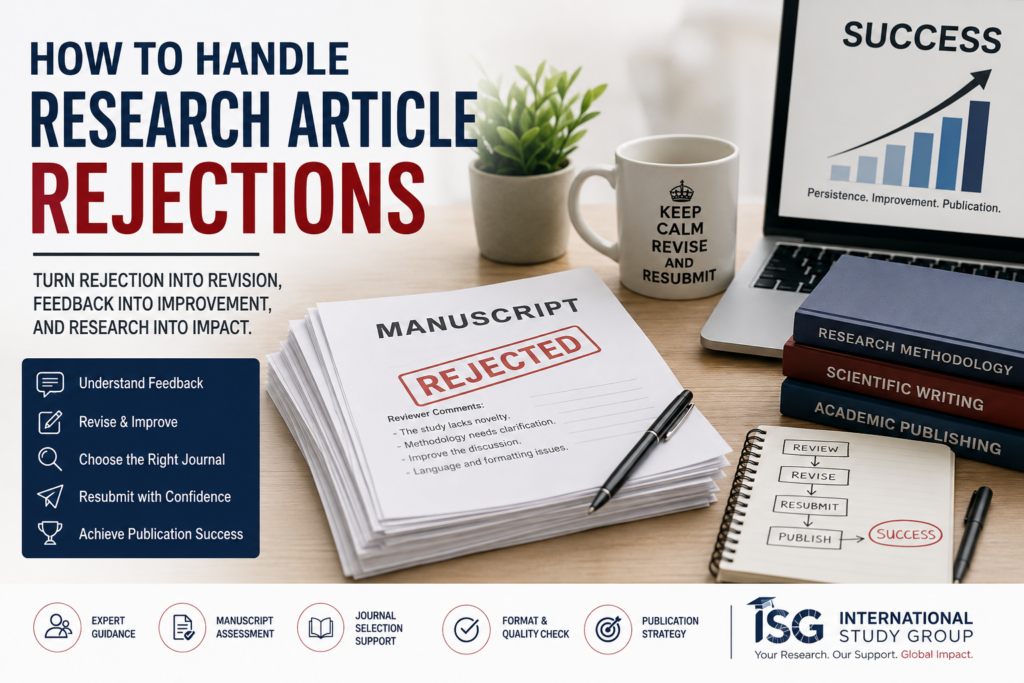
Receiving a rejection for a research article can be discouraging, especially after months of research, data collection, analysis and manuscript preparation. However, a research article rejection does not necessarily mean that your research has no value. In academic publishing, rejection is a common part of the publication process. Even experienced researchers may receive rejection decisions from reputable journals before successfully publishing their work.
The key is to understand why the manuscript was rejected, evaluate the editor and reviewer comments objectively, improve the paper and identify a more suitable journal or publication strategy. Instead of treating rejection as the end of the research publication journey, researchers can use it as an opportunity to strengthen their manuscript.
At International Study Group (ISG), we help researchers approach publication challenges systematically by supporting areas such as manuscript assessment, journal selection, formatting, plagiarism checks, submission preparation and publication planning. This article explains how researchers can respond to a rejected research paper and how professional research publication support can make the next submission more strategic.
Why Are Research Articles Rejected?
Before deciding what to do after a journal rejection, researchers should understand the possible reasons behind the decision. A manuscript may be rejected because of academic, technical, methodological, editorial or journal-specific issues.
1. Scope Mismatch
One of the most common reasons for manuscript rejection is submitting a paper to a journal that does not match the subject area or scope of the research. A high-quality paper can still be rejected if its topic does not align with the journal's readership and aims.
Researchers should carefully review the journal's aims and scope before submission. The title, abstract, methodology and findings should have a clear connection with the subjects regularly published by the journal.
2. Methodological Weaknesses
Reviewers may identify weaknesses in research design, sample selection, data collection, statistical analysis, experimental procedures or interpretation of results. If the methodology does not adequately support the conclusions, the manuscript may be rejected.
Researchers should examine methodological comments carefully and determine whether additional analysis, clarification or supporting evidence is required.
3. Poor Manuscript Structure
A research paper should normally present a logical flow from the introduction and literature review to methodology, results, discussion and conclusion. Poor organization, unclear writing or weak transitions can make it difficult for reviewers to understand the contribution of the research.
4. Insufficient Originality or Novelty
Journals look for research that contributes something meaningful to existing knowledge. If the manuscript does not clearly explain what is new about the study, reviewers may question its significance.
The introduction and literature review should establish the research gap, while the conclusion should clearly explain how the study contributes to the field.
5. Formatting and Journal Guidelines
Every journal has its own submission requirements. These may include reference style, manuscript structure, word limits, figure formats, tables, supplementary information and ethical declarations. Failure to follow these requirements can result in editorial rejection or delays.
6. Language and Presentation Problems
Academic research needs to be presented clearly and professionally. Grammar problems, unclear sentences, inconsistent terminology and poor academic writing can affect how reviewers interpret the research. Language issues do not necessarily indicate weak research, but they can make the manuscript difficult to evaluate.
7. Similarity or Ethical Concerns
High similarity with previously published material, inappropriate citation practices, duplicate submission, questionable authorship or inadequate ethical documentation can create serious publication problems. Researchers should check these aspects before submitting or resubmitting a manuscript.
What Should You Do After a Research Paper Rejection?
The first step after receiving a rejection is to avoid making an immediate emotional decision. Read the editor's decision letter carefully and identify the specific reason for rejection.
Research article rejections generally fall into different categories. An editorial rejection may occur before peer review because of scope, quality, formatting or journal suitability. A peer-review rejection may occur after reviewers have evaluated the manuscript and identified significant concerns. Some decisions may also invite substantial revision before resubmission.
Understanding the type of rejection is important because the next action will depend on the reason for the decision.
Step 1: Read the Reviewer Comments Carefully
Reviewer comments should not be viewed simply as criticism. They can provide valuable information about how experts perceive the manuscript. Create a list of every major and minor comment and categorize them into methodology, literature review, analysis, writing, formatting, references and presentation.
Some comments may be subjective, while others may identify genuine weaknesses. Researchers should distinguish between the two and prioritize issues that affect the scientific validity and clarity of the study.
Step 2: Identify the Core Problem
Do not immediately submit the rejected manuscript to another journal without reviewing it. If the same methodological or presentation problem remains, another journal may reach a similar conclusion.
Ask important questions: Is the research question clearly defined? Is the literature review current and relevant? Is the research gap clearly explained? Is the methodology sufficiently detailed? Are the results appropriately analyzed? Do the conclusions follow from the evidence? Does the manuscript make its contribution clear?
Step 3: Revise the Manuscript
Once the weaknesses have been identified, revise the manuscript systematically. Major revisions may involve restructuring sections, improving statistical analysis, adding relevant literature, clarifying methodology or strengthening the discussion.
Minor revisions may include correcting grammar, improving figures, changing references, adjusting formatting and responding to specific reviewer concerns.
It is important to maintain a record of the changes made. A revision checklist can help researchers ensure that important reviewer comments are not overlooked.
Step 4: Reconsider Your Journal Selection
A rejection can sometimes indicate that the selected journal was not the right fit for the manuscript. Researchers should evaluate the journal's scope, subject area, article types, indexing status, readership, publication model and submission requirements before selecting the next journal.
Choosing a journal solely because it has a high reputation or impact factor may not be the best strategy. The journal should be appropriate for the research topic, methodology and academic contribution.
Step 5: Check the Manuscript Before Resubmission
Before submitting the revised manuscript to another journal, conduct a complete quality check. Review the manuscript structure, references, citations, figures, tables, ethical statements, author information and formatting requirements.
A plagiarism or similarity check can also help identify passages that require rewriting, quotation or additional citation. Researchers should always follow responsible academic writing and publication ethics.
How International Study Group Helps Researchers Handle Article Rejections
International Study Group (ISG) approaches research publication as a process rather than simply a submission activity. When a manuscript is rejected, the objective should be to understand the reason, improve the paper and develop a suitable publication strategy.
Manuscript Assessment
ISG can help researchers review the overall presentation of their manuscript and identify areas that may require improvement before another submission. This can include reviewing the manuscript structure, research gap, academic presentation, references and journal compatibility.
Journal Selection Support
Selecting the appropriate journal is an important part of the publication process. ISG can assist researchers in evaluating potential journals based on subject relevance, scope, publication requirements and the researcher's publication objectives.
A targeted journal selection strategy can reduce unnecessary submissions to unsuitable journals and help researchers focus on publications that are more relevant to their research area.
Formatting and Technical Preparation
Different journals use different manuscript templates and formatting requirements. ISG can support researchers in preparing manuscripts according to the selected journal's requirements, including references, tables, figures and overall document presentation.
Proper formatting does not guarantee acceptance, but it helps ensure that avoidable technical issues do not become an additional obstacle during editorial screening.
Plagiarism and Similarity Checks
Researchers should evaluate the originality and citation practices of their manuscript before submission. ISG provides support with similarity checking and helps researchers identify sections that may require rewriting, proper attribution or improved citation.
Submission Preparation
A successful submission involves more than uploading a manuscript. Researchers may need to prepare a cover letter, author declarations, graphical abstracts, supplementary files, ethical statements and other journal-specific documents.
ISG can help researchers organize the submission requirements and prepare the manuscript for submission according to the selected journal's guidelines.
Resubmission Strategy
When a manuscript has been rejected, the next journal should be selected strategically rather than randomly. ISG can help researchers evaluate the previous rejection, identify areas for improvement and develop a revised submission approach.
The objective is not to guarantee acceptance but to improve the manuscript's quality, journal suitability and overall readiness for peer review.
Should You Appeal a Research Article Rejection?
In some cases, an appeal may be appropriate. If the researcher believes that the editor or reviewers misunderstood a significant aspect of the study or that important evidence was overlooked, a professional appeal may be considered.
However, an appeal should be based on clear academic reasoning rather than disagreement with the rejection itself. Researchers should carefully follow the journal's appeal policy and provide specific evidence supporting their request for reconsideration.
How to Avoid Repeated Research Paper Rejections
Repeated rejection can often be reduced by developing a structured publication workflow. Researchers should begin with a clear research question and strong literature review, select an appropriate methodology, maintain accurate records, conduct appropriate analysis and clearly communicate the contribution of the research.
Before submission, researchers should also verify journal scope, indexing information, author guidelines, reference requirements, ethical requirements and manuscript formatting.
Another important factor is avoiding rushed submissions. A manuscript should ideally go through several stages of quality control before being submitted to a journal.
Research Article Rejection Is Not the End
A rejected research paper is not necessarily a failed research project. Academic publishing involves evaluation, revision and repeated improvement. Researchers can use rejection feedback to strengthen their manuscript and improve their publication strategy.
The most important lesson is to separate the rejection of a manuscript from the value of the researcher and the research itself. A paper may be rejected because of journal scope, presentation, methodology, novelty, formatting or other factors. Understanding the reason allows researchers to make informed decisions about what to do next.
Get Research Publication Support from International Study Group
If your research article has been rejected, do not immediately give up or submit the same manuscript to another journal without assessment. Review the rejection, understand the concerns, improve the manuscript and select the next journal carefully.
International Study Group (ISG) supports researchers through different stages of the academic publication process, including manuscript assessment, journal selection, formatting, similarity checking and submission preparation. Our approach is designed to help researchers make informed publication decisions and improve the readiness of their manuscripts.
Whether you are preparing your first research article or looking for a better strategy after a journal rejection, a structured approach can make the publication process more manageable.
Ready to take the next step with your research publication? Connect with International Study Group to discuss your manuscript and publication requirements.
Frequently Asked Questions About Research Article Rejections
Can a rejected research paper be published in another journal?
Yes. A rejected manuscript can often be revised and submitted to another suitable journal, provided there are no restrictions from the previous journal and the manuscript is not under simultaneous consideration elsewhere. Researchers should address important concerns before resubmission.
Does journal rejection mean my research is poor?
No. Rejection can occur for several reasons, including journal scope, methodology, novelty, formatting, presentation or editorial priorities. Researchers should evaluate the specific rejection comments before judging the quality of their research.
How can I improve a rejected research paper?
Start by analyzing the editor and reviewer comments. Identify major weaknesses, revise the manuscript, improve academic presentation, verify references and formatting, and select a journal that is appropriate for the research.
Can ISG help after a research paper rejection?
Yes. International Study Group can provide support in areas such as manuscript assessment, journal selection, formatting, similarity checking and submission preparation. The exact support required depends on the manuscript and the reason for rejection.
How should I select another journal after rejection?
Evaluate the journal's aims and scope, subject area, article type, publication requirements, indexing claims, readership and suitability for your research. Avoid selecting a journal solely because it appears prestigious or promises fast publication.
Conclusion
Handling research article rejection requires strategy, patience and objective evaluation. Instead of viewing rejection as the final outcome, researchers should use reviewer feedback as an opportunity to improve their work. A systematic approach involving manuscript revision, journal selection, formatting, quality checks and ethical publication practices can strengthen the next submission.
With the right guidance and a well-planned publication strategy, researchers can turn the experience of a rejected manuscript into an important step toward successful academic publication. International Study Group is committed to supporting researchers throughout this journey with practical research publication assistance and structured submission support.