
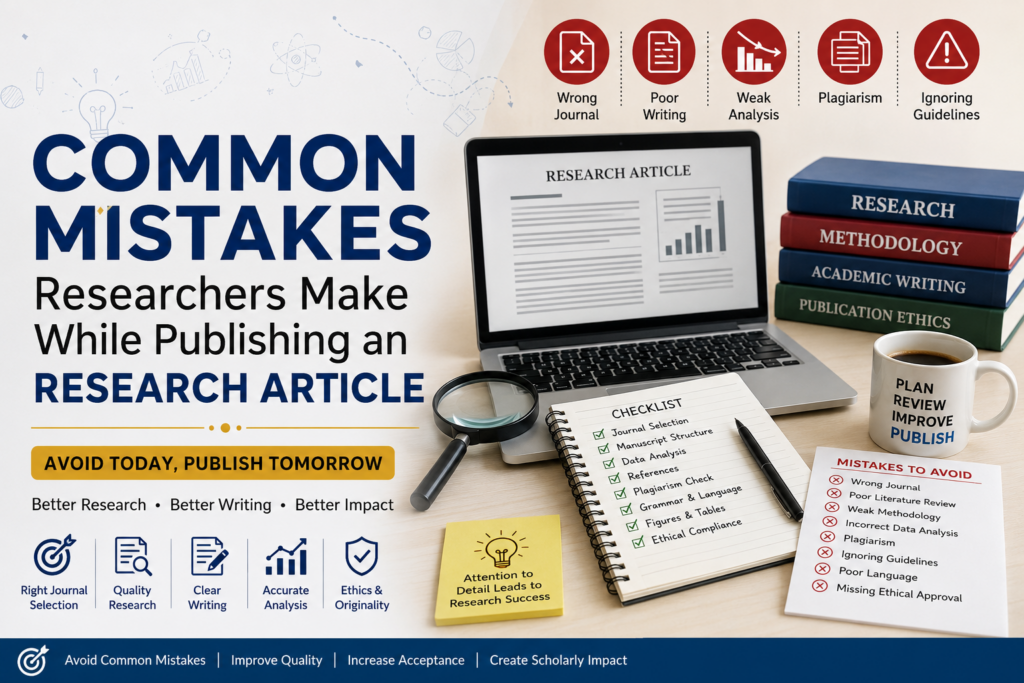
Publishing a research article in a reputed journal is one of the most significant milestones in an academic career. Whether you’re aiming for Scopus, SCI, Web of Science, or PubMed indexed journals, publishing requires much more than conducting quality research. Thousands of manuscripts are rejected every year due to avoidable mistakes rather than poor research quality.
Many researchers, especially first-time authors, spend months or even years conducting research but overlook essential aspects of manuscript preparation and journal submission. Understanding these common pitfalls can significantly improve your chances of publication.
In this comprehensive guide, we discuss the most common mistakes researchers make while publishing research articles and how to avoid them.
1. Choosing the Wrong Journal
One of the biggest reasons for immediate rejection is submitting to an unsuitable journal.
Many authors focus only on the journal’s Impact Factor without checking whether their research aligns with the journal’s scope and readership.
Common Errors
- Ignoring the journal’s aims and scope
- Submitting multidisciplinary research to a highly specialized journal
- Targeting journals solely based on Impact Factor
- Ignoring acceptance rates and review timelines
How to Avoid It
- Read the journal’s scope carefully.
- Review recently published articles.
- Check indexing status.
- Match your research topic with the journal’s audience.
2. Poor Literature Review
A weak literature review indicates insufficient understanding of existing research.
Many researchers cite outdated references or fail to identify research gaps.
Common Errors
- Using old references
- Overlooking recent developments
- Excessive self-citations
- Missing landmark studies
Best Practice
Include recent references from the last five years whenever possible and clearly explain how your research contributes to existing knowledge.
3. Weak Research Objectives
Editors often reject manuscripts when the research objectives are vague or poorly defined.
Common Mistakes
- Undefined research questions
- Broad objectives
- No measurable outcomes
- Lack of novelty
Solution
Clearly state:
- Research problem
- Objectives
- Hypothesis
- Expected contribution
4. Poor Research Methodology
A strong methodology determines the credibility of research.
Common problems include incomplete experimental details and inadequate statistical analysis.
Avoid
- Small sample size without justification
- Missing control groups
- Poor data collection methods
- Incomplete methodology description
Always ensure your methodology is detailed enough for another researcher to replicate your work.
5. Weak Data Analysis
Even excellent research can fail if the data analysis is poor.
Common Issues
- Incorrect statistical tests
- Misinterpreting results
- Selective reporting
- Unsupported conclusions
Use appropriate statistical software and seek expert review when necessary.
6. Poor Manuscript Structure
A well-organized manuscript significantly improves readability.
Many submissions fail because they do not follow the journal’s prescribed format.
Typical Problems
- Weak abstract
- Long introduction
- Unclear discussion
- Missing conclusion
- Poor figure placement
A standard research article should include:
- Title
- Abstract
- Keywords
- Introduction
- Literature Review
- Methodology
- Results
- Discussion
- Conclusion
- References
7. Ignoring Journal Guidelines
Every journal has unique formatting requirements.
Ignoring them often leads to desk rejection before peer review.
Common Formatting Errors
- Incorrect referencing style
- Wrong font size
- Improper figure resolution
- Exceeding word limits
- Incorrect table formatting
Always download the journal’s author guidelines before submission.
8. Plagiarism
Plagiarism remains one of the leading causes of manuscript rejection.
Even accidental plagiarism can damage an author’s academic reputation.
Types of Plagiarism
- Direct plagiarism
- Self-plagiarism
- Mosaic plagiarism
- Improper citation
Best Practice
Maintain similarity below the journal’s acceptable threshold (typically under 10–15%, though requirements vary). Properly cite all sources and use plagiarism detection software before submission.
9. AI-Generated Content Without Human Review
Artificial Intelligence tools are becoming increasingly popular in academic writing. However, relying entirely on AI-generated content can introduce factual inaccuracies, fabricated references, inconsistent writing styles, and ethical concerns.
Common Mistakes
- Copying AI-generated text without verification
- Using fabricated citations
- Ignoring journal policies on AI use
- Failing to disclose AI assistance where required
Best Practice
Use AI tools only to support writing tasks such as language improvement or brainstorming. Carefully review, verify, and edit all content to ensure originality, accuracy, and compliance with the journal’s AI policy.
10. Poor English and Grammar
Editors often reject manuscripts that are difficult to read.
Language issues can hide the value of quality research.
Common Problems
- Grammatical errors
- Poor sentence structure
- Inconsistent terminology
- Ambiguous writing
Professional proofreading before submission can substantially improve readability.
11. Low-Quality Figures and Tables
Visual presentation matters.
Poor-quality figures reduce the professional appearance of a manuscript.
Common Mistakes
- Low-resolution images
- Unreadable charts
- Missing figure captions
- Inconsistent formatting
Ensure figures meet the journal’s resolution and formatting requirements.
12. Incorrect References
13. Ignoring Ethical Requirements
Research ethics are essential for publication.
Failure to comply may result in immediate rejection.
Examples
- Missing ethical approval
- No informed consent
- Undisclosed conflicts of interest
- Duplicate publication
Always include ethical approval numbers and declarations where applicable.
14. Weak Discussion Section
Many researchers simply repeat their results instead of interpreting them.
A strong discussion explains:
- Why the findings matter
- How they compare with previous studies
- Practical implications
- Study limitations
- Future research directions
This demonstrates the significance of your work and strengthens the manuscript.
15. Submitting Without Internal Review
Many avoidable errors can be identified before submission.
Before submitting:
✔ Ask colleagues to review your manuscript.
✔ Obtain language editing if necessary.
✔ Verify references.
✔ Check plagiarism.
✔ Confirm formatting.
✔ Review journal guidelines again.
A thorough pre-submission review can significantly improve the quality of your paper.
Quick Pre-Submission Checklist
Before clicking “Submit,” ensure that you have:
- Selected the most appropriate journal
- Clearly defined research objectives
- Conducted a comprehensive literature review
- Followed the journal’s formatting guidelines
- Checked grammar and language
- Verified references and DOIs
- Screened the manuscript for plagiarism
- Prepared high-quality figures and tables
- Included all ethical declarations
- Written a compelling abstract and conclusion
- Reviewed the manuscript with colleagues or mentors
Publishing a research article is a rigorous process that demands careful planning, attention to detail, and adherence to ethical and editorial standards. While manuscript rejection is a common part of academic publishing, many rejections stem from avoidable mistakes rather than weak research itself.
By selecting the right journal, presenting your work clearly, following submission guidelines, maintaining research integrity, and thoroughly reviewing your manuscript before submission, you can significantly improve your chances of acceptance in reputable journals such as Scopus, SCI, Web of Science, and PubMed.
Remember that successful publication is not only about producing valuable research—it is also about communicating your findings effectively, transparently, and professionally. Investing time in refining your manuscript today can lead to greater visibility, stronger academic impact, and more successful publishing outcomes in the future.
Frequently Asked Questions (FAQs)
Find answers to the most common questions researchers have about publishing research articles.
The most common reasons include submitting to the wrong journal, poor manuscript quality, plagiarism, weak methodology, failure to follow journal guidelines, and language issues.
Most reputed journals prefer similarity below 10–15%. However, each journal has its own policy, so always check the author's guidelines before submission.
Yes. AI tools can assist with grammar, language improvement, and brainstorming ideas. However, researchers are responsible for verifying the accuracy, originality, citations, and compliance with journal policies.
Select a journal based on its scope, indexing (Scopus, SCI, Web of Science, PubMed), audience, impact, acceptance rate, review timeline, and publication ethics.
Yes. Professional proofreading improves readability, grammar, and clarity, allowing reviewers to focus on your scientific contribution rather than language mistakes.
Peer review typically takes between 4 weeks and 6 months, depending on the journal, reviewer availability, and the number of revision rounds.
Predatory journals charge publication fees without providing proper peer review or editorial standards. Always verify a journal's indexing, publisher reputation, and editorial board before submitting your manuscript.
Yes. Revise your manuscript based on reviewer comments, choose a more suitable journal, and ensure it meets the new journal's submission requirements.
Contact International Study Group
Looking for assistance with Scopus, SCI, Web of Science, PubMed publications, plagiarism checking, AI detection, or research paper editing at an affordable cost? Fill out the form and connect with our experts instantly.
📞 Call / WhatsApp
+91 81229 81179🌐 Organisation
International Study Group (ISG)
🕘 Office Hours
Monday – Saturday
9:30 AM – 6:30 PM (IST)